


 Call Us Now
 Email Us Now
Understanding Drug Possession Charges Without Ever Holding the Drugs
Key Takeaways: Constructive possession allows Massachusetts prosecutors to charge someone with drug possession even if the drugs were never physically on them, as long as the person knew about the controlled substance and had both the ability and intention to control it. The doctrine hinges on knowledge plus the ability and intention to exercise dominion and control rather than direct physical contact. Private spaces and exclusive access strengthen a charge while shared vehicles or common areas weaken it. Under G.L. c. 94C, § 34, the government must prove knowing or intentional possession, and the substance’s class determines penalties, which range from fines and house-of-correction time to enhanced state prison terms for repeat offenses. Large quantities or evidence of sales can escalate simple possession into possession with intent to distribute under § 32A. Common defenses focus on gaps in proving knowledge and control, shared access, and constitutional issues. Because these cases are highly fact-dependent, consulting a knowledgeable Massachusetts criminal defense attorney early can help protect your rights.
You can be charged with drug possession in Massachusetts even if the drugs were never in your hands, pocket, or anywhere on your body. Constructive possession is a legal doctrine allowing prosecutors to pursue charges when a person has knowledge of a controlled substance along with the ability and intention to exercise dominion and control over it. Many people are surprised to face serious accusations after a search of a home, bag, or shared vehicle.
If you or someone you love is under investigation or already charged, working with a knowledgeable Criminal Defense Attorney in Massachusetts can help you understand the accusations and possible paths forward. Toland Law offers guidance for people facing these exact situations. You can reach the team through the firm’s website, call 781-819-3647, or use the confidential contact form to discuss your circumstances.
The Core Legal Meaning of Constructive Possession
Constructive possession is best understood as control over drugs rather than direct physical contact with them. Courts recognize a distinction between actually holding a substance and having the practical power to manage or access it. The ability to control an asset, even without actual possession of it, is the foundational idea, as explained in the widely referenced definition of constructive possession under criminal law.
The doctrine generally requires more than mere presence near a controlled substance. Prosecutors typically must show knowledge plus the ability and intention to exercise dominion and control over the item. Because these cases are fact-sensitive, the outcome often depends on the specific evidence.
Actual vs. Constructive Possession in Massachusetts
The difference between actual and constructive possession often decides how a case is charged and defended. Actual possession means a substance is found directly on a person, such as in a pocket or hand. Constructive possession applies when drugs are located somewhere the person knows about and can reach or control, even in their absence.
Private spaces tend to strengthen a constructive possession theory, while shared or public areas can weaken it. Police finding cocaine in a bedroom chest of drawers during a search can support a charge based on control over that private space, though presence in the home alone is insufficient without additional evidence. Exclusive access matters, courts may consider evidence such as holding exclusive keys to a safety box at a bank where contraband is discovered.
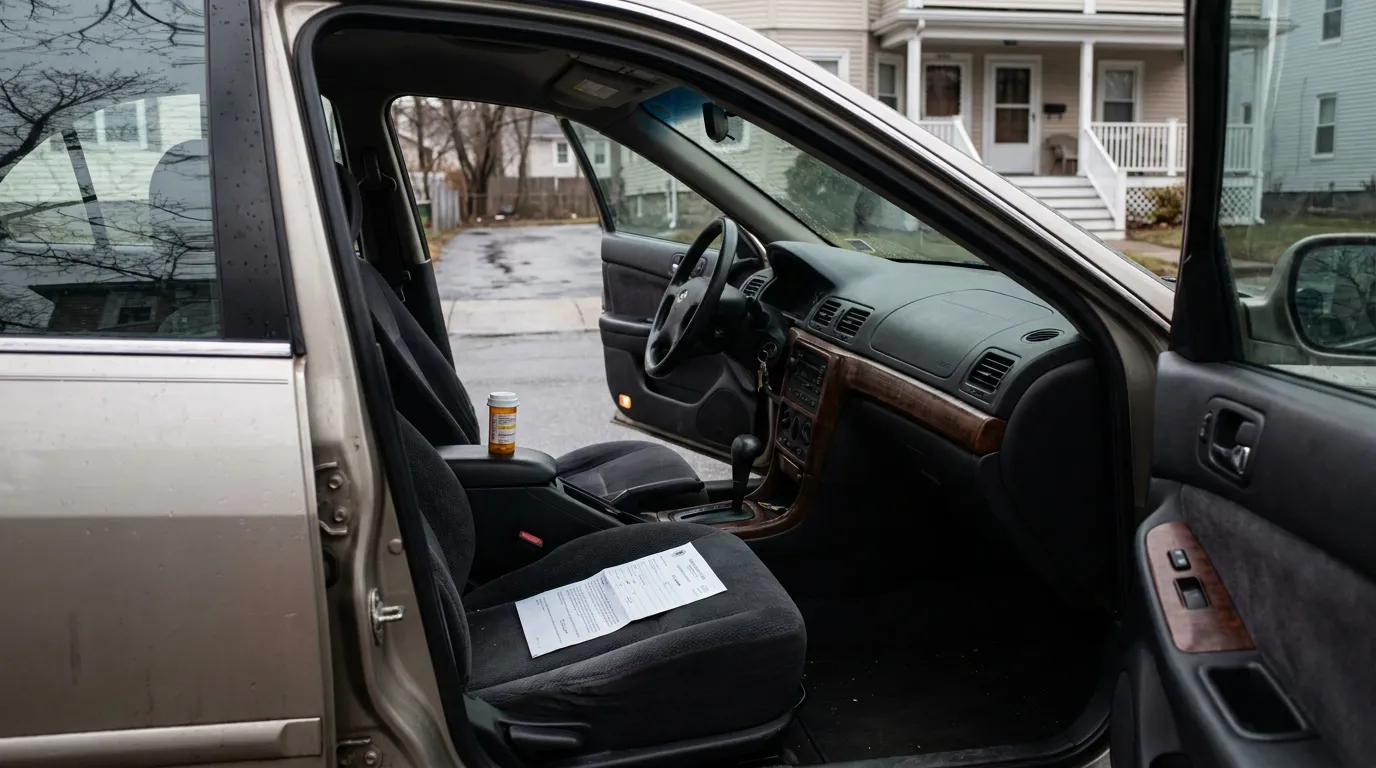
Shared access, however, can cut the other way. In a shared vehicle drug charge in Massachusetts or a common living area, the question of who controlled the substance becomes far more complicated. This is why many drug possession cases turn on careful factual analysis.
How Massachusetts Law Defines the Underlying Offense
Massachusetts drug possession is governed primarily by G.L. c. 94C, § 34. That statute prohibits knowing or intentional possession of a controlled substance without proper authorization. The full text of M.G.L. c. 94C, § 34 provides that no person knowingly or intentionally shall possess a controlled substance unless obtained directly, or pursuant to a valid prescription or order, from a practitioner.
The statute’s mental-state requirement is central to how constructive possession works. M.G.L. c. 94C, § 34 requires possession to be knowingly or intentionally, meaning prosecutors must prove the accused knew about the substance and had both the ability and intention to control it. A genuine lack of knowledge or control can undermine the prosecution’s theory.
Chapter 94C also sorts controlled substances into classes that affect penalties. There are five classes of controlled substances ranging from Class A through Class E. The class in which a drug falls under § 31 determines the applicable penalty statute.
Penalties That May Apply Under Chapter 94C
Penalties for drug possession in Massachusetts vary by substance and prior record. For a first offense involving heroin, consequences include up to two years in a house of correction or a fine of not more than $2,000, with state prison terms of two and one-half to five years for subsequent offenses.
Constructive possession can also escalate into more serious charges under M.G.L. c. 94C, § 32A. Large quantities or evidence of intent, such as labeled baggies and notebooks with names, quantities, and prices, may lead to possession with intent to distribute charges.
The table below summarizes selected penalty frameworks. Actual exposure depends on the facts, substance, and prior history.
| Offense Type | Statute | General First-Offense Exposure |
|---|---|---|
| Heroin possession | G.L. c. 94C, § 34 | Up to 2 years in a house of correction or up to $2,000 fine |
| Class B possession with intent | G.L. c. 94C, § 32A(a) | Up to 10 years in state prison, or up to 2½ years in jail, or $1,000, $10,000 fine |
Repeat offenses generally carry enhanced penalties. Under section 32A(a), a conviction may bring imprisonment in state prison for not more than 10 years, or in a jail or house of correction for not more than two and one-half years, or a fine of $1,000 to $10,000. For those with prior controlled substance convictions, section 32A(d) provides subsequent convictions are punishable by state prison for not more than 15 years and/or a fine of $2,500 to $25,000. Certain distribution offenses under § 32A also carry mandatory minimum terms.
Common Defenses a Criminal Defense Attorney in Massachusetts May Explore
A skilled Criminal Defense Attorney in Massachusetts often begins by challenging whether the prosecution can prove knowledge and control. Because constructive possession depends on more than proximity, defenses frequently focus on gaps in the government’s evidence.
Shared or public access is a recurring theme in possession defense strategies. A baggie of cocaine found under a lobby sofa cushion accessible to all residents does not establish possession. When many people could have controlled the substance, constructive possession theory may fail.
Potential defense angles include:
- Lack of knowledge: The accused may not have known the substance was present.
- Absence of control: Access shared with others, such as in a shared vehicle, can weaken the claim of dominion.
- Constitutional challenges: Issues involving probable cause, search and seizure, or Miranda warnings may affect admissible evidence.
- Chain-of-custody or evidentiary flaws: Questions about evidence handling can matter significantly.
💡 Pro Tip: If police search a space you share with others, avoid making statements about who owns or controls items before speaking with counsel. Casual comments can later be treated as admissions of knowledge or control.
Toland Law focuses on protecting constitutional rights across a wide range of matters. You can learn more about the firm’s approach to criminal defense in Massachusetts, which covers drug offenses and related charges. For broader educational reading, the firm’s collection of legal insights offers helpful background for those facing Massachusetts drug charges.
Frequently Asked Questions
1. Can I be convicted if the drugs were not mine?
Possibly, but the prosecution must prove more than ownership. Under M.G.L. c. 94C, § 34, the government must show knowing or intentional possession, which requires knowledge along with the ability and intention to control the substance. If those elements are missing, constructive possession may not hold.
2. Does being a passenger in a car make me guilty of possession?
Not automatically. Mere presence in a shared vehicle generally does not establish control over drugs found inside. Courts examine who had access, knowledge, and the ability to exercise dominion.
3. How is constructive possession different from actual possession?
Actual possession involves direct physical control, while constructive possession involves the knowledge of and ability to control drugs without holding them. Both can lead to charges under M.G.L. Chapter 94C.
4. Can a possession charge become a distribution charge?
Yes, under certain circumstances. Large quantities or indicators of sales, such as packaging materials or transaction records, may support a charge under M.G.L. c. 94C, § 32A with significantly greater potential penalties.
5. What should I do if I am charged with constructive possession?
Consider speaking with a criminal defense attorney in Massachusetts as early as possible. Outcomes depend heavily on the specific facts, evidence, and how the search was conducted. Prompt legal guidance can help preserve important rights and defenses.
Protecting Your Rights After a Drug Possession Accusation
Constructive possession is a nuanced doctrine that can expose people to serious charges even when they never physically held a controlled substance. Massachusetts law under Chapter 94C requires proof of knowledge along with the ability and intention to control the substance, and the specific class of substance shapes the penalties. Because these cases are fact-dependent, the difference between actual vs constructive possession, the presence of shared access, and the quality of evidence can all influence the result.
If you are facing Massachusetts drug charges and want to understand your options, Toland Law is ready to help you evaluate your situation. Reach out through the firm’s main website, call 781-819-3647 to speak with the team, or submit your details through the secure contact page to take the next step toward a strong controlled substance defense.